
Sensis Sales Tool
Took a promising but undefined technology experiment from concept to finished, user-validated product in four weeks. User testing shifted the entire direction of the tool to something far more useful than what had been initially conceived.
Overview
Sensis had built an API that aggregated online data about a business (presence, performance, gaps) and could see its potential as a sales tool. But they hadn’t yet worked out what to actually build with it. Sales staff were getting by with a patchwork of workarounds and third-party services to identify customer needs, and there was no coherent product tying it together.
Four weeks from kickoff to finished product. More importantly, the design process itself surfaced a fundamental insight that changed what the tool became.
The Challenge
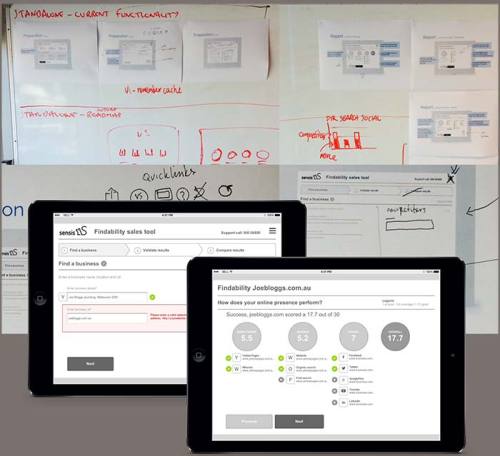
Great technology without a clear use case is a common trap. Sensis had the data capability. What they needed was a product design process that could rapidly move from whiteboard to working software while keeping real users at the centre of every decision.
There was also an internal resistance to overcome: early hesitancy from the team about testing with sales staff directly. Getting past that resistance turned out to be one of the most important moments in the project.
My Role
I led the UX design process end-to-end, from initial whiteboarding through to testing with users and informing the final developed product.
What I Did
Ran a rapid, user-centred design process. The approach was deliberately fast and informal, moving quickly from whiteboarding to prototyping to user testing. In four weeks, we had a finished product. The speed was only possible because every decision was grounded in what we were learning from users rather than internal debate.
Pushed for testing with sales staff. Despite initial resistance, I made the case for putting prototypes directly in front of the sales team. Once the broader team sat in on a session and heard how sales staff actually needed the tool to work for them, the resistance evaporated immediately.
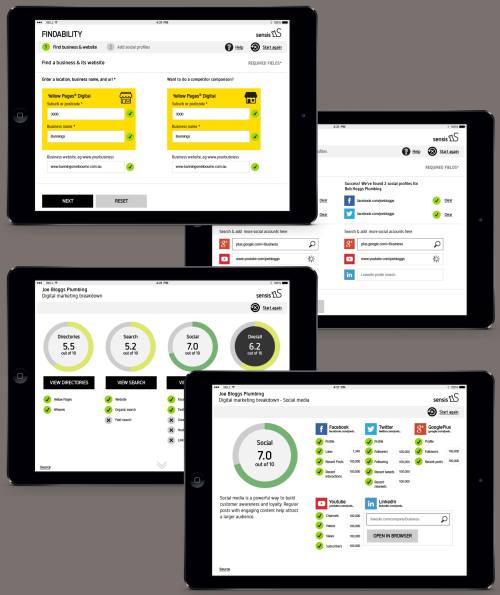
Let users reshape the product. What the sales team told us during testing fundamentally changed the direction of the tool. The original concept was useful, but what users actually needed was a comparative tool: a way to benchmark a client’s online performance against competitors or best-in-market examples. That shift made it significantly more valuable as a sales instrument.
Result
A finished, validated product in four weeks, and one that was meaningfully better than what had been initially conceived, because we tested it with the people who would actually use it.
The lesson here isn’t about speed, though four weeks is fast. It’s about what happens when you remove the hesitation to put work in front of real users early. The sales team’s input didn’t just refine the tool. It transformed it. That’s exactly what user testing is for.